General Information
-
DRAMP ID
- DRAMP03304
-
Peptide Name
- Hydramacin-1 (Hm-1; annelida, animals)
-
Source
- Hydra vulgaris (Hydra) (Hydra attenuata)
-
Family
- Belongs to the macin family
-
Gene
- Not found
-
Sequence
- QIVDCWETWSRCTKWSQGGTGTLWKSCNDRCKELGRKRGQCEEKPSRCPLSKKAWTCICY
-
Sequence Length
- 60
-
UniProt Entry
- B3RFR8
-
Protein Existence
- Protein level
-
SMILES
- Not available
Activity Information
-
Biological Activity
- Antimicrobial, Antibacterial, Anti-Gram+, Anti-Gram-
-
Target Organism
-
- Gram-negative bacteria:
Target Organism Activity Acinetobacter baumannii ATCC 19606 MBC=7.1 µM Burkholderia cepacia ATCC 25416 MBC>14.3 μM Burkholderia cepacia ATCC 17759 MBC>14.3 μM B. cepacia LMG 16654 MBC>14.3 μM Citrobacter freundii NCTC 9750 MBC=7.1 μM C. freundii C7 MBC=0.9 μM Enterobacter cloacae Va11263/03 MBC>14.3 μM E. cloacae Va12270/03 MBC=0.9 μM Escherichia coli ATCC 25922 MBC=0.9 μM Klebsiella pneumoniae ATCC 13883 MBC=0.9 μM Klebsiella oxytoca ATCC 13182 MBC=0.9 μM Proteus mirabilis ATCC 21100 MBC=14.3 μM P. vulgaris ATCC 13315 MBC>14.3 μM Providencia rettgeri NCTC 7475 MBC>14.3 μM Pseudomonas aeruginosa NCTC 11446 MBC>14.3 μM Salmonella typhimurium 10003442 MBC=0.9 μM S. typhimurium 10003630 MBC=0.9 μM Serratia marcescens Mero060/148 MBC>14.3 µM S. marcescens Mero103/013 MBC>14.3 μM S. marcescens NCTC 10211 MBC>14.3 μM Yersinia enterocolitica NCTC 11176 MBC=0.9 µM - Multi-resistant Gram-negative bacteria:
Target Organism Activity Escherichia coli Co 86 ESBL MBC=3.6 μM Klebsiella oxytoca ESBL 33 MBC=7.1 µM K. oxytoca ESBL 37 MBC=3.6 μM Klebsiella pneumoniae ATCC 700603 MBC=3.6 μM - Gram-positive bacteria:
Target Organism Activity Staphylococcus aureus ATCC 6538 MBC>14.3 μM Staphylococcus haemolyticus ATCC 29970 MBC=1.8 μM Streptococcus pyogenes ATCC 12344 MBC>14.3 μM - Multi-resistant Gram-positive bacteria:
Target Organism Activity Staphylococcus aureus ATCC 33593 (MRSA) MBC>14.3 μM Enterococcus faecalis ATCC 51299 MBC>14.3 μM
- Gram-negative bacteria:
-
Hemolytic Activity
-
- No hemolysis information or data found in the reference(s) presented in this entry
-
Cytotoxicity
-
- Not included yet
-
Binding Target
- cell membrane
Structure Information
-
Linear/Cyclic
- Not included yet
-
N-terminal Modification
- Not included yet
-
C-terminal Modification
- Not included yet
-
Nonterminal Modifications and Unusual Amino Acids
- Not included yet
-
Stereochemistry
- Not included yet
-
PDB ID
- 2K35 resolved by NMR.
-
Predicted Structure
-
- Please click DRAMP03304_predicted_structure.pdb to download.
Physicochemical Information
-
Formula
- C300H471N91O88S8
Absent Amino Acids
- FHM
Common Amino Acids
- CK
Mass
- 7017.08
PI
- 9.05
Basic Residues
- 12
Acidic Residues
- 6
Hydrophobic Residues
- 12
Net Charge
- +6
-
Boman Index
- -154.34
Hydrophobicity
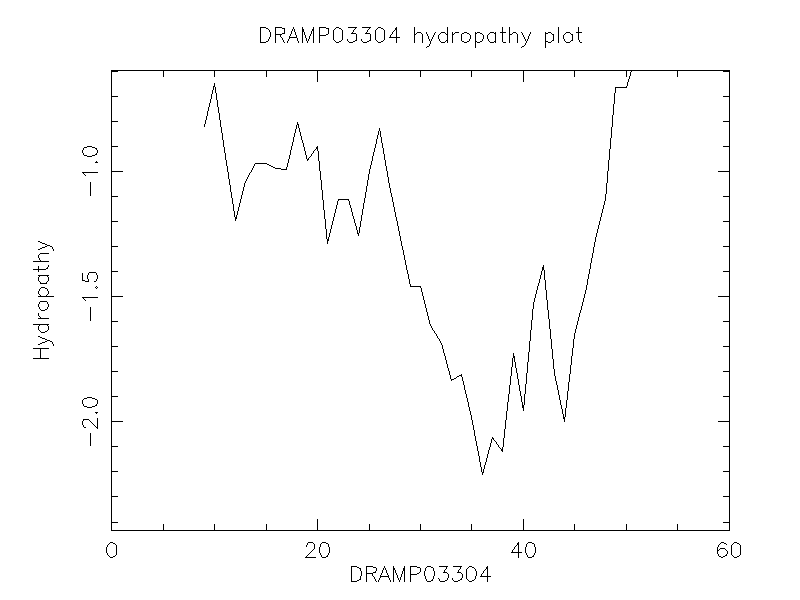
- -0.948
Aliphatic Index
- 39
Half Life
-
- Mammalian:0.8 hour
- Yeast:10 min
- E.coli:>10 hour
Extinction Coefficient Cystines
- 29490
Absorbance 280nm
- 499.83
Polar Residues
- 25
DRAMP03304
Comments Information
Function
- Hydramacin-1 is potently active against Gram-positive and Gram-negative bacteria including multi-resistant human pathogenic strains. Is not active against the Gram-positive Coccus species, Gram-negative non-fermentation species and against the fungus C.albicans. It leads to aggregation of bacteria as an initial step of its bactericidal mechanism. Aggregated cells are connected via electron-dense contacts and adopt a thorn apple-like morphology. Hydramycin contains a belt of positively charged residues that separate two hydrophobic areas. This structure may explain the observed aggregation of bacteria, since each of these areas can immerse into the outer leaflets of the membranes of two individual bacteria. Is able to permeabilize membranes of viable bacteria at low and neutral pH values, but no pore-forming activity is not detected.
Tissue specificity
- Expressed in the endodermal epithelium.
Induction
- By bacterial lipopolysaccharides (LPS).
PTM
- Contains four disulfide bonds.
Literature Information
- ·Literature 1
-
Title
- Uncovering the evolutionary history of innate immunity: the simple metazoan Hydra uses epithelial cells for host defence.
-
Pubmed ID
- 19013190
-
Reference
- Dev Comp Immunol. 2009 Apr;33(4):559-569.
-
Author
- Bosch TC, Augustin R, Anton-Erxleben F, Fraune S, Hemmrich G, Zill H, Rosenstiel P, Jacobs G, Schreiber S, Leippe M, Stanisak M, Grötzinger J, Jung S, Podschun R, Bartels J, Harder J, Schröder JM.
- ·Literature 2
-
Title
- Hydramacin-1, structure and antibacterial activity of a protein from the basal metazoan Hydra.
-
Pubmed ID
- 19019828
-
Reference
- J Biol Chem. 2009 Jan 16;284(3):1896-1905.
-
Author
- Jung S, Dingley AJ, Augustin R, Anton-Erxleben F, Stanisak M, Gelhaus C, Gutsmann T, Hammer MU, Podschun R, Bonvin AM, Leippe M, Bosch TC, Grötzinger J.

